
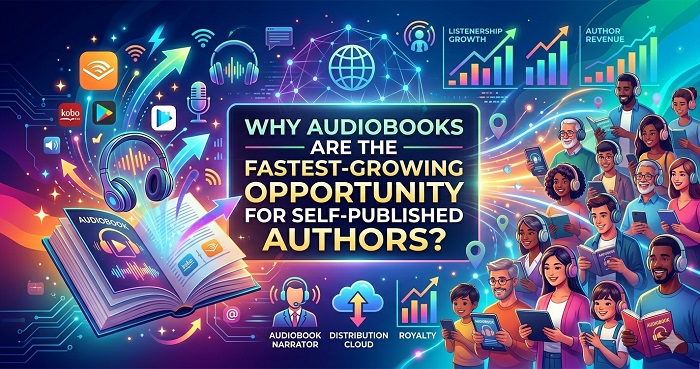
Why Audiobooks Are the Fastest-Growing Opportunity for Self-Published Authors?
You’ve already done the hard part: written the book, published it, put it out there. But if it only exists in print or as an ebook, a growing chunk of your potential audience will never find it. Not because they don’t read. Because they listen and that is where audiobook publishing services play a crucial role.
US audiobooks sales hit $2.22 billion in 2024. Audio has quietly overtaken ebooks in market share and it keeps climbing. The listeners driving that number aren’t waiting for traditional publishers to catch up. They’re on Audible, Spotify, and Apple Books right now, looking for their next title.
The tools available to indie authors today mean there’s no real reason to sit this out. The question is just how to start.
The Shift That Actually Helps Indie Authors
Traditional publishers have always had audiobooks. That’s not new. What’s new is that indie authors now have access to the same production pipeline, without signing over control to get there.
Self-publishing your audiobook means you keep full rights to your work. You decide the narrator, the timeline, the pricing, and where it sells. You’re not waiting on a publisher’s schedule or splitting earnings to the fraction of a penny.
The royalty difference alone is significant. Traditional deals often leave authors with single-digit percentages. Self-published authors keep the majority of what their audiobooks earns.
The production gap that once separated indie authors from traditional publishers has closed. The tools exist. The platforms exist. The audience is already there.
Three Ways to Produce Your Audiobook — Pick What Fits
Most authors get stuck here. Production feels like the complicated part. It doesn’t have to be.
Hire a narrator through a platform like ACX
This works best for fiction romance, thriller, and fantasy, where voice and character carry the story. You audition narrators, pick one, and they record your book professionally. Costs typically run $200–$400 per finished hour. If the upfront budget is tight, a royalty share is an option: no payment now, but you split earnings with the narrator long-term. One thing to factor in experienced narrators are less likely to take royalty-share projects, so your choices narrow.
Work with a full-service provider
Good audiobook publishing services take it from manuscript to finished file, including casting, recording, and production. Higher cost upfront, but you stay out of the weeds. If you want a clean result without managing every moving part yourself, this is the straightforward path.
Use AI narration
Fast and affordable. Works well for non-fiction, business, and how-to content where the writing does the heavy lifting. The honest part, listener tolerance for AI voices is still inconsistent. For fiction, especially, it can affect how readers connect with the book. It’s a valid option, just know what you’re choosing before you commit.
Don’t Just Publish on Audible
Audible is the obvious starting point. Most authors go there first and never look further. Big doesn’t mean complete.
ACX gets you on Audible, Amazon, and Apple Books. The catch exclusive agreements tie you down for seven years. No flexibility, no expanding without restrictions.
INaudio, formerly Findaway Voices, works differently. No exclusivity. Your audiobook reaches 40+ retailers across 170 countries, including Spotify, Kobo, Google Play, and library platforms. Several audiobook production companies include distribution setup as part of their package, so you’re not figuring that out separately after production wraps.
In 2024, over 70% of audiobooks sales came through subscription platforms. Listeners browse libraries. They don’t hunt for specific titles.
Narrow distribution means a smaller slice of that. Wide distribution means you’re actually in the room.
Which Books Actually Work as Audiobooks
Fiction leads. Romance, thriller, and fantasy have loyal listener bases that consume fast and return for more. If you write in these genres, audio isn’t optional. It is where your readers already are.
Non-fiction holds its own. Business, self-help, and personal development fit the format naturally. People listen during commutes, workouts, and downtime. The content marketing lands the same way it does on the page, sometimes better.
Shorter works are worth considering. A focused how-to guide, a business framework, or a tight novella costs significantly less to produce than a full-length title and converts just as well with the right audience.
Serialized audio is picking up heading into 2026. Shorter installments released over time keep listeners engaged without requiring a full production budget upfront.
If you’ve already written the book, the format question is simpler than it looks.
FAQs
How much does audiobook production cost for self-published authors?
Production costs typically run $200–$400 per finished hour when hiring a narrator. Full-service packages vary by provider. Royalty-share options are available if upfront budget is a concern.
Which is better — ACX or wide distribution for indie authors?
ACX works well for Audible reach, but it locks you into a 7-year exclusive agreement. Wide distribution through platforms like INaudio gets your audiobooks on 40+ retailers with no exclusivity required. Most authors benefit from going wide.
Can I self-publish an audiobook without recording it myself?
Yes. You can hire a narrator through platforms like ACX, work with a full-service production provider, or use AI narration tools. Recording yourself is an option, but not a requirement.
How to Get Your Audiobook Out There
The authors building listener bases right now are the ones who’ll own that audience when the market gets crowded, and it will.
The entry point looks different for everyone. Some authors hire a narrator and manage production themselves. Others hand the entire project to a team. Both paths work. The difference is time, budget, and how involved you want to be.
What matters is making the decision. Your book already exists. The audience is already listening. The only thing missing is your audiobooks being in front of them.
The right audiobook publishing services make the difference between a title that sits untouched and one that reaches listeners who’d never pick up a print copy.

I am a seasoned voice in the UK publishing industry. I specializes in bridging the gap between the written word and the spoken performance. With a deep understanding of acoustic aesthetics and narrator selection, I provide authors with actionable insights on transforming manuscripts into immersive auditory experiences.